Showing posts with label Department of Transportation. Show all posts

Weekly Wrap Up: A Great Pumpkin

A quick look at the week of October 25, 2010:

It's the Great Pumpkin:

White HouseQuote: “My favorite image will be the one I take tomorrow.” – Pete Souza, Chief Official White House Photographer and Director of the White House Photography Office, in a live video chat on WhiteHouse.gov. http://wh.gov/3wX and Souza's ten favorite photos: http://wh.gov/3mn

Your West Wing Week: "The Mysterious Case of Mysterious Case 55" Video: http://wh.gov/3dR

Fresh on Twitter: PressSec Something new: You take first crack. Use #1q in a q & I'll answer 1 on vid before today's briefing. What do you want to know? (Answer: http://wh.gov/3dN)

Actions We’re Taking: President Obama speaks on the security situation regarding suspicious packages bound for the United States. http://wh.gov/3wp

The Daily Show: President Obama talks to Jon Stewart: http://wh.gov/3p1

Notable Number: 2%. The Gross National Product (GDP) – a key measurement of our economic growth – grew at a 2.0% annual rate over the last three months. Video: The President on accelerating recovery: http://wh.gov/3vL

Energy Vampires: Secretary Chu says slay "energy vampires" (appliances that suck up energy even when turned off): http://on.fb.me/9HRA9c

National Energy Awareness Month: Solar panels on the White House and in the desert, 36 billion gallons of biofuels, and cleaner trucks: http://wh.gov/3vi

A First for Trucks and Buses: A proposal for the first national standards for emissions and fuel efficiency: http://wh.gov/3PP

Leveling the Playing Field: Elizabeth Warren talks about standing up the new Consumer Financial Protection Bureau: http://is.gd/gpqS9

You Asked, Axe: Answered: Senior Advisor to the President, David Axelrod, answered your questions in Tuesday Talks this week: http://wh.gov/3Vy

California Women's Conference: First Lady Michelle Obama and Dr. Jill Biden go West: http://wh.gov/3Ev

The Science Guy: Check out a behind the scenes video from the White House Science Fair, including Bill Nye: http://wh.gov/3yh

It’s a Bird, It’s a Plane…It’s a High-Speed Train: The Department of Transportation awards $2.4 billion to continue developing high-speed passenger rail corridors: http://wh.gov/3pV

DOT Awards $2.4 Billion to Continue Developing 21st Century High-speed Passenger Rail Corridors

Cross posted from the Department of Transportation's blog.

Today, the Obama Administration and the Department of Transportation are awarding $2.4 billion for planning and construction of intercity passenger rail service. With these 54 projects in 23 states, we're moving full-speed ahead toward a nationwide high-speed rail system.

President Obama signed the Recovery Act to build bridges between the Americans who needed jobs and the infrastructure jobs that needed doing. One of those jobs was creating a 21st century rail system in the United States.


White HouseThe $8 billion in the Recovery Act for high-speed rail was step one, a down payment on a national network that, within 25 years, will give 80% of Americans the choice of traveling from downtown to downtown by high speed passenger train.

With today's awards, we take a second step toward that future. A future that envisions riding from downtown Los Angeles to downtown San Francisco in two hours and forty minutes. Or Chicago to St. Louis in two hours. Or Tampa to Orlando in 55 minutes.


White HouseThe intense demand for high-speed rail dollars demonstrates just how important this historic initiative is. We received 132 applications for $8.8 billion, more than three times the funding Congress made available. Across the country, states are seeing the future and clamoring for passenger rail routes. That's why we've already expanded to include a route from Iowa City to Chicago--running through the Quad Cities--and a route in Michigan connecting Detroit to Chicago via Kalamazoo.

States understand that high-speed rail represents a unique opportunity to revitalize our manufacturing base, spur economic development, and create jobs.

Workers will be needed to lay track and manufacture rail cars. And more than 30 rail manufacturers and suppliers, both domestic and foreign, have agreed to establish or expand bases of operations in the US if they are hired to build America's next generation high-speed lines. The Obama Administration secured this commitment to ensure that new jobs are created here at home.

And, because proximity to rail stations will be increasingly valuable, growing rail lines will also stimulate economic development.


White HouseThere are other benefits beyond jobs, economic growth, and greater mobility. Rail routes will alleviate congestion on crowded highways and allow freight to flow more freely by truck. Train passengers will forego crowded airports often located more than an hour outside of a city's central business district.

And all of these intercity routes will be cleaner and greener than our current options, easing our reliance on imported oil and mitigating carbon emissions on our environment.

White HouseEvery vision this nation ever realized began with a few courageous steps. If we put off high-speed rail by saying it will take too long to build, then it will never happen. President Eisenhower took a step forward at the birth of the US Interstate Highway network in the 1950s, and today that system is the life-blood of American commerce and mobility.

Now it's time for another bold step. The America I grew up in didn't just happen. Our nation's progress was only made possible through the imagination, investment, and hard work of those who came before. And I’m proud that, today, we’re adding to that legacy with President Obama's commitment to high speed rail.

Five Years Later, Our Commitment Continues

It's difficult to look back on the devastation caused by Hurricane Katrina with anything but sadness. Sadness for the lives lost, sadness for the displacement of so many people.

As we mark the fifth anniversary of Katrina, there is still work to be done. And the Department of Transportation's (DOT) commitment to help rebuild Gulf communities remains strong.

Five Years Later, Our Commitment Continues

In the aftermath of Hurricane Katrina, Ready Reserve vessels from DOT's Maritime Administration (MARAD) housed emergency workers and served as a temporary headquarters for the Port of New Orleans. The Pipelines and Hazardous Materials Safety Administration assisted in the design and operation of emergency fuel distribution networks, which were needed to provide gas and diesel for generators at local hospitals and to support emergency relief operations. And the Federal Transit Administration (FTA) initiated free transit service to temporary housing sites.

The Federal Highway Administration (FHWA) got to work fixing several key highways that had been dramatically disabled by Hurricane Katrina. One of the more striking of these disruptions was the I-10 Twin Spans bridge connecting the area east of New Orleans with Slidell, Louisiana. Emergency repairs were made immediately. But, since then, the FHWA has provided $800 million in sole-support for construction of a new, sturdier bridge. When opened in 2011, the bridge will help keep this vital supply and evacuation lifeline open in future storms.


Five Years Later, Our Commitment ContinuesMore recently, the American Reinvestment and Recovery Act has helped DOT continue aiding Katrina rebuilding efforts. Thanks to the Recovery Act, the FHWA is fixing the interchange of I-10 and the Lake Pontchartrain Causeway. Now, this interchange in Metairie serves more than 178,000 drivers daily--a number expected to grow to 246,000 by 2026--and is one of the worst traffic choke-points in all of Louisiana. Yet I-10 is one of the most important routes for goods and people into and out of New Orleans. A $51 million Recovery Act grant has fully funded flyover ramps to expand the interchange's capacity and adds capacity to local collector streets.

In all, there are eight different projects improving various sections of I-10 in Jefferson and Orleans Parishes.

And the FTA has awarded more than $66 million in Recovery Act transit grants in Louisiana, $25 million in Mississippi, and $50 million in Alabama. Whether for repairs or expansion projects, these grants are helping position area transit agencies to provide better services to residents.

Five Years Later, Our Commitment ContinuesImmediately after Hurricane Katrina, the FTA established the "Bus Bridge" between Baton Rouge and New Orleans. For four years, evacuees in Baton Rouge could visit their properties, pursue repairs, and go to work in New Orleans via this service, dubbed LA Swift. Last year, thanks to FTA support, the emergency free service transitioned to a permanent, fee-based route, indicating that Gulf residents, even those who own cars, have embraced public transit as a beneficial way of getting around.

That's why FTA's dedication to improving transit services in the region has not faded. FTA recently announced improvements to public transit in New Orleans, including a new streetcar loop in the city's central business district. This urban circulator is expected to stimulate economic development along its route and enhance New Orleans' livability in years to come.
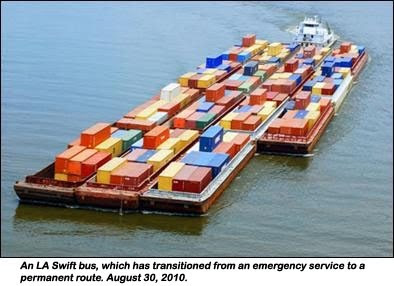
Five Years Later, Our Commitment ContinuesMARAD's America's Marine Highways program is also working to restore the shipping capabilities of the Mississippi River and its port communities. We recognize how critical it is to support jobs up and down the river. And our marine highways have the added benefit of reducing road congestion and greenhouse gas emissions for people who live in the region.

As we look back on the devastation caused by Hurricane Katrina, of course we are reminded of how far we have yet to go to restore these communities. But this Administration is committed to helping Gulf residents rebuild, and here at DOT we will continue to do all we can to support that effort.

Building Our Cities Greener

Earlier this week, we took another big step forward in the Obama Administration’s efforts to encourage more sustainable development as we announced $100 million for our new Sustainable Communities Regional Planning Grant program to encourage regions to integrate economic development, land use, and transportation investments – which will help to tie the quality and location of housing to broader opportunities such as access to good jobs, quality schools, and safe streets. For all the implications of “sprawl”—from job loss, economic decline and segregation, to obesity, asthma rates, to climate change and our dangerous dependence on foreign oil—all of them share by one fundamental problem: the mismatch between where we live and where we work. Whatever else we do to address these problems, America must find a way to connect housing to jobs. And Americans are demanding it. Today, the average household spends more than half of its budget on housing and transportation.
They have become American families’ two single biggest expenses. During the housing boom, real estate agents suggested to families that couldn’t afford to live near job centers that they could find a more affordable home by living farther away. Lenders bought into the “Drive to Qualify” myth as well – giving easy credit to homebuyers without accounting for how much it might cost families to live in these areas or the risk they could pose to the market. And then, an odd thing happened when these families moved in – they found themselves driving dozens of miles to work, to school, to the movies, to the grocery store, spending hours in traffic and spending nearly as much to fill their gas tank as they were to pay their mortgage...and in some places, more. In addition to adding to families’ budgets and time, it is also contributing to increased carbon emissions and pollution. In all, in the last century, transportation costs as a share of household expenditures have increased by a thousand percent.

In February, HUD launched our new Office of Sustainable Housing and Communities – allowing us to work directly with communities to support innovative planning and practice at the local level and helping to coordinate our investments with other agencies at the federal level. In particular, HUD formed a Sustainability Partnership with the Department of Transportation and the Environmental Protection Agency. When it comes to housing, environmental and transportation policy, the Federal government must speak with one voice. This is an example of how we’re changing the way we do business across the Administration – working not at cross purposes in our silos, but together, in common purpose

Of course, as critical as regional planning is, the hard work of implementing plans happens at the local level.
That’s why our $40 million Sustainable Communities Challenge Planning Grant program is targeted to cities and towns. I announced this program earlier this week in conjunction with Transportation Secretary Ray LaHood in a joint grant program that includes up to $35 million for its “TIGER II” planning grant program.
Where the Transportation program will fund planning activities that relate directly to a future transportation capital investment, HUD’s program will fund land-use related planning activities and affordable housing strategies that will be linked to that investment. This funding will make it possible for communities to hire staff with the expertise needed to remove barriers communities face to sustainable development.

The goal of each of these efforts—at the regional level, at the community level and at the neighborhood level—is the same: to advance our shared priorities and values as Americans for the decades to come.Priorities like jobs for the 21st century – located closer to where we live, so businesses spend less money moving goods and services and people can spend less time commuting and more time with family.Values like healthier, more inclusive communities – with neighborhoods where kids can play outside and breathe clean air.

Communities where opportunities for people of all ages, incomes, races and ethnicities are never determined by their zip code.These are the kinds of communities we all want our children to grow up in.If, in this new century, we grow our communities and our economies out of this fundamental principle, then I have no doubt our America and our children’s America will be a strong, prosperous America infused with the same sense of purpose, opportunity and resolve that have always defined us.