Showing posts with label Consumer Protection Act. Show all posts

Improving Financial Education in America

Empowering Americans to make good financial decisions for themselves and their families is necessary to building a financially stronger America. To meet this goal, we must improve Americans’ understanding of financial products and terms, expand financial access, and provide appropriate and robust consumer protection. President Obama is committed to building a country in which more families have the knowledge, skills, and financial access to make good financial choices and to establishing the consumer protections that enable and encourage them to do so.

As part of this commitment, President Obama issued an Executive Order establishing the President’s Advisory Council on Financial Capability (“Council”) and appointed a highly qualified group of men and women from the private and non-profit sectors to advise him on these critical issues. The Council, which will work at the direction of Treasury Secretary Tim Geithner, will advise the President on how to maximize the effectiveness of existing private and public sector financial education efforts and identify new approaches to increase financial capability for all Americans.

Making sure Americans have the information they need to make smart financial choices is a cornerstone of a number of Administration efforts. One of the central aspects of the Dodd-Frank Wall Street Reform and Consumer Protection Act, which President Obama signed in to law on July 21, 2010, is the creation of the Consumer Financial Protection Bureau, whose sole mission is to look out for American consumers and empower them with the clear and concise information they need to make the financial decisions that are best for them and their families. The Bureau will create a level playing field for all providers of consumer financial products and services, regardless of their charter or corporate form and will ensure high and uniform standards across the market. It will rein in misleading sales pitches and hidden traps, and foster competition on the basis of price and quality. In addition, it will help lead efforts to increase financial capability by establishing an Office of Financial Education.

The Treasury Department will convene the Council’s first meeting in November with the purpose of laying out its agenda and goals for the upcoming months. This is another aggressive step forward in building a stronger America. An America where working hard and playing by the rules means security for our families and hope for our future. Where firms compete based on price and quality, not tricks and traps. Where old fashion values of thrift are rewarded and consumers have the knowledge and access to make good choices for themselves and their families. And where once again America leads the world.
What You Missed: Tuesday Talk with Elizabeth Warren

This week we kicked off Tuesday Talks, a weekly live video chat, with Elizabeth Warren, who is leading efforts to set up the Consumer Financial Protection Bureau (CFPB) – one of the central aspects of the Wall Street Reform and Consumer Protection Act that the President signed in July.

Check out what you missed and join us next week.


Use the links below to jump directly to a question (questions are paraphrased).

Why President Obama is Not Signing H.R. 3808

Today, the White House announced that President Obama will not sign H.R. 3808, the Interstate Recognition of Notarizations Act of 2010, and will return the bill to the House of Representatives. The Interstate Recognition of Notarizations Act of 2010 was designed to remove impediments to interstate commerce. While we share this goal, we believe it is necessary to have further deliberations about the intended and unintended impact of this bill on consumer protections, including those for mortgages, before this bill can be finalized.

Notarizations are important for a large range of documents, including financial documents. As the President has made clear, consumer financial protections are incredibly important, and he has made this one of his top priorities, including signing into law the strongest consumer protections in history in the Wall Street Reform and Consumer Protection Act. That is why we need to think through the intended and unintended consequences of this bill on consumer protections, especially in light of the recent developments with mortgage processors.

The authors of this bill no doubt had the best intentions in mind when trying to remove impediments to interstate commerce. We will work with them and other leaders in Congress to explore the best ways to achieve this goal going forward.

Your Credit Card Bill of Rights Now in Full Effect

Today, the last reform provisions of the Credit Card Accountability, Responsibility and Disclosure (CARD) Act – also known as the Credit Card Bill of Rights – took effect. The CARD Act of 2009 marked a turning point for American consumers, putting an end to the days of unfair rate hikes and hidden fees.The President released the following statement on the CARD Act implementation:

Last year, I signed the Credit Card Accountability, Responsibility and Disclosure Act into law to put a stop to deceptive credit card practices and hold credit card companies accountable to their customers. Yesterday, the final reform provisions of the CARD Act took effect. As of today, consumers will be protected against unreasonable fees and penalties for late payments, as well as unfair practices involving gift cards. This law will also make the terms of credit cards more understandable and puts a stop to hidden over-the-limit fees and other practices designed to trap consumers. It restricts rate increases that apply retroactively to old balances. And the CARD Act prevents companies from increasing rates within the first year an account is opened.

In addition, the Wall Street Reform and Consumer Protection Act I signed into law last month will empower a new Consumer Financial Protection Bureau with just one job: looking out for consumers in our financial system. This includes making sure that credit card reforms are implemented forcefully and that big banks and lenders are living up to their responsibilities under the law. And in the wake of a terrible recession, these reforms and this independent consumer watchdog will not only protect consumers, they’ll strengthen our economy as a whole, leveling the playing field for responsible lenders and ensuring that families and small business owners are better able to make financial decisions that work for them.

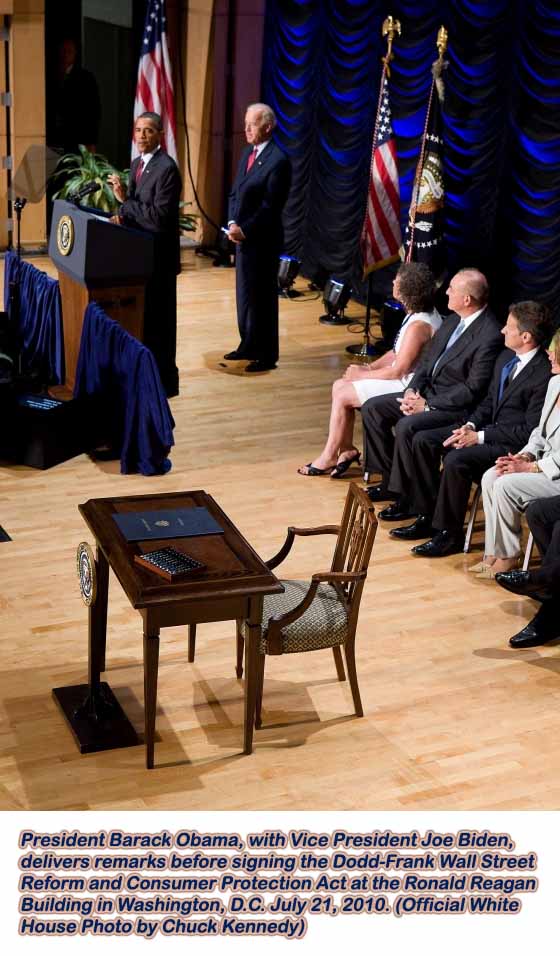
President Obama Signs Wall Street Reform: "No Easy Task"

This morning the President signed yet another landmark piece of legislation putting the middle class above the special interests that for so long had a stranglehold on America's government. To get an entertaining overview of what's involved in Wall Street Reform, from ending bailouts and holding Wall Street accountable to the strongest consumer protections ever, take a few minutes to watch our entertaining animated video or get into the nuts and bolts on our Wall Street Reform page. At the signing ceremony, the President laid out the historical perspective as well as the perspective focused on our common future:
Passing this bill was no easy task. To get there, we had to overcome the furious lobbying of an array of powerful interest groups and a partisan minority determined to block change. So the members who are here today, both on the stage and in the audience, they have done a great service in devoting so much time and expertise to this effort, to looking out for the public interests and not the special interests. (Applause.) And I also want to thank the three Republican senators who put partisanship aside -- (applause) -- judged this bill on the merits, and voted for reform. We’re grateful to them. (Applause.) And the Republican House members. (Applause.) Good to see you, Joe. (Applause.)
Now, let’s put this in perspective. The fact is, the financial industry is central to our nation’s ability to grow, to prosper, to compete and to innovate. There are a lot of banks that understand and fulfill this vital role, and there are a whole lot of bankers who want to do right -- and do right -- by their customers. This reform will help foster innovation, not hamper it. It is designed to make sure that everybody follows the same set of rules, so that firms compete on price and quality, not on tricks and not on traps.
It demands accountability and responsibility from everyone. It provides certainty to everybody, from bankers to farmers to business owners to consumers. And unless your business model depends on cutting corners or bilking your customers, you’ve got nothing to fear from reform. (Applause.)
Now, for all those Americans who are wondering what Wall Street reform means for you, here’s what you can expect. If you’ve ever applied for a credit card, a student loan, or a mortgage, you know the feeling of signing your name to pages of barely understandable fine print. What often happens as a result is that many Americans are caught by hidden fees and penalties, or saddled with loans they can’t afford.
That’s what happened to Robin Fox, hit with a massive rate increase on her credit card balance even though she paid her bills on time. That’s what happened to Andrew Giordano, who discovered hundreds of dollars in overdraft fees on his bank statement –- fees he had no idea he might face. Both are here today. Well, with this law, unfair rate hikes, like the one that hit Robin, will end for good. (Applause.) And we’ll ensure that people like Andrew aren’t unwittingly caught by overdraft fees when they sign up for a checking account. (Applause.)
With this law, we’ll crack down on abusive practices in the mortgage industry. We’ll make sure that contracts are simpler -– putting an end to many hidden penalties and fees in complex mortgages -– so folks know what they’re signing.
With this law, students who take out college loans will be provided clear and concise information about their obligations.
And with this law, ordinary investors -– like seniors and folks saving for retirement –- will be able to receive more information about the costs and risks of mutual funds and other investment products, so that they can make better financial decisions as to what will work for them.
So, all told, these reforms represent the strongest consumer financial protections in history. (Applause.) In history. And these protections will be enforced by a new consumer watchdog with just one job: looking out for people -– not big banks, not lenders, not investment houses -– looking out for people as they interact with the financial system.

http://whitehouse-org.blogspot.com/

The Top 10 Things You May Not Know About the Wall Street Reform and Consumer Protection Act

Here are 10 aspects of the Wall Street Reform and Consumer Protection Act you may not know about -- the online attention-deficit version.
  1. Stronger protections for consumers against unfair credit card practices like rate hikes for existing credit card balances.
  2. Mortgage brokers will be prohibited from making higher commissions by selling mortgages they know consumers can’t afford.
  3. Free annual credit scores so people can stay on top of their finances. [Clarification: free credit scores are available if you receive worse terms on a loan because of something on your credit report, or if you are rejected.]
  4. No more taxpayer-funded bailouts. If a company can’t make it, it will have to liquidate.
  5. Greater input by company shareholders over how much a CEO gets paid. And companies’ compensation boards are now required to be truly independent.
  6. Brokers who offer investment advice will have to act in the best interests of their customers, not their own financial interests.
  7. Financial firms won't be allowed to grow so large that if one fails, it will affect the entire financial system.
  8. There will be one agency whose sole job is to make sure that consumers get the protections they deserve and to set clear rules to hold banks, mortgage companies, payday lenders, and credit card lenders accountable.
  9. Businesses can't be charged extra fees for debit card “swipe fees” that exceed the cost of processing transactions.
  10. You can learn plenty more here at WhiteHouse,gov or at financialstability.gov
  11. Updated: To tack on #11, here's a new animated video we've released to further explain Wall Street Reform.
  12.